Best loyalty tools and solutions in 2025
Download the report



Recently, iGaming businesses, regulators, technology providers, and support organizations have gathered for the fifth European Safer Gambling Week. According to the organizer, the European Gaming and Betting Association (EGBA), the initiative’s purpose is to inform individuals about healthy gaming habits. At the same time, it enables stakeholders to share their knowledge and best practices on creating and maintaining safer gaming environments.
Similar initiatives take place across the globe throughout the year, reflecting the relevance of responsible gaming in public discourse.
Responsible gaming refers to a set of principles, tools, and practices aimed at fostering the culture of iGaming as a form of leisure. This goal is related to preventing gambling addiction and helping those affected by it.
Casino gaming addiction, also known as compulsive gambling or gambling disorder, is a state when a person can no longer control their craving for gaming despite the toll it takes on all areas of their life: social and professional functioning, personal relationships, and mental and physical health. Individuals with this condition often feel preoccupied with gaming, needing to stake ever-increasing amounts of money to feel the desired thrill, and repeatedly unsuccessfully trying to cut down on playing or stop it.
In 2024, Ukrainian experts surveyed 7,870 players to create a socio-psychological portrait of a pathological casino gamer. The findings revealed that 94% of respondents admitted they struggled to resist the urge to play. Among those identified as pathological players, 95% reported spending more money and time than they had planned, and 96% felt guilty for engaging in this activity.
The concept of responsible gaming has been gaining momentum as awareness of the nature and negative impact of problem gaming has grown, driven by accumulating psychological and social research.
Since the 2000s, the gaming environment has drastically changed. Following responsible gaming principles is more important than ever due to several factors.
Growing accessibility. Before the internet era, casino gaming was, in most cases, confined to licensed premises, out of reach of people under 18. Nowadays, iGaming and betting are available 24/7 from almost any location via smartphones.
KYC in question. This factor stems from the ease of access to online casino games. Operators that don’t require KYC for playing or withdrawing funds pose risks for people whose passion for playing has turned into a harmful habit. Such businesses contribute to the problem and sully the reputation of legitimate industry players.
Legalization. The legalization of iGaming and sports betting can contribute to the surge in problem gaming. In 2025, the researchers discovered a substantial increase in help-seeking for casino addiction following the legalization and expansion of online and land-based sportsbooks in the U.S. These businesses were allowed to operate officially after the Murphy v. NCAA Supreme Court ruling, which enabled states to legalize them.
Advertising. Exposing minors, current or past problem gamers, and other vulnerable groups to casino ads can also lead to an increase in gambling disorder cases. For this exact reason, governments and digital advertising platforms strictly control the targeting requirements and content of ad creatives. Violating these guidelines can cost iGaming brands a lot: they might get their ad accounts suspended, be fined, or even have their licenses revoked. We have thoroughly explored advertising restrictions and legal ad tactics in a dedicated article — feel free to check it out.
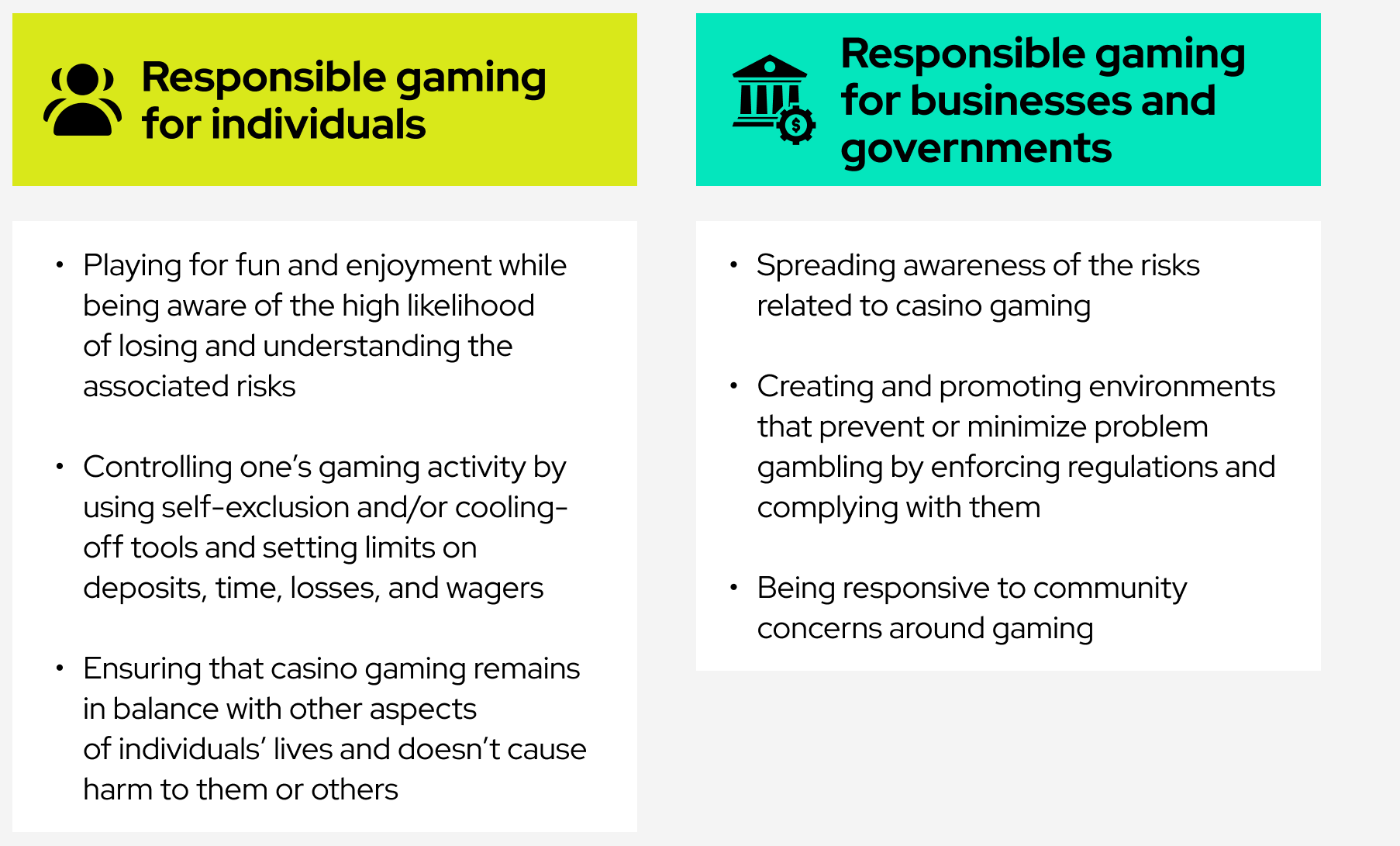
Gaming addiction is a multidimensional problem; therefore, numerous entities should join forces to prevent and/or minimize its consequences: iGaming brands and casinos, software vendors, governments, and players themselves. In other words, responsible gaming centers around corporate, state, and personal responsibility.
One part of iGaming operators’ job is raising awareness about the issue. They must inform customers about the risks associated with excessive gaming, offer tips on playing without harming one’s welfare, and place visible links to helplines and support organizations. Creating interactive content can help businesses convey valuable information without boring players. They come to the casino to have fun, after all. For instance, quizzes are great for this purpose, notes Trueplay’s Partnership Manager Felipe Leão Cunha. “We introduced such a quiz for Brazil’s market. It allows players to better understand the purpose of responsible gaming practices, self-check their knowledge of local regulations, spot symptoms of casino addiction, and discover effective strategies to fight it.”
The quiz can complement operators’ education campaigns on problem gaming. To motivate users to complete it, businesses can offer bonuses.
“Gamified and incentivized education transforms responsible gaming from a mere compliance requirement into a habit that players willingly adopt. When learning feels rewarding, safety becomes part of the fun,” adds Felipe.
Casinos must give players the means to control their activity — responsible gaming tools. These include:
Providers of casino platforms must include these features.
Designing player experience in a way that doesn’t entice harmful play is another strategy. Behavioral scientist Patrick Fagan points out that it’s possible to disrupt the so-called dark flow state, where a person “is very tunnel-vision focused on something to the detriment of everything else.” The expert mentions a study indicating that casinos that banned smoking saw a decrease in problematic play. Stepping outside for a smoke allowed customers to break away from that intense focus. Adding brief puzzles between rounds can work the same way.
Real-time player behavior monitoring can help operators flag players who may be at risk and trigger interventions, such as pop-ups prompting users to activate self-exclusion tools or seek help from client support agents who can then direct them to counselors. Software used for this purpose usually tracks bet sizes, play frequency, session length, and wins and losses.
Governments play a critical role in promoting responsible gambling by enforcing licensing requirements, monitoring operator compliance, funding public health initiatives, and partnering with advocacy groups.
Licensing operators. State entities require casinos to obtain licenses to operate legally in specific markets. Licenses always include responsible gaming compliance.
Compliance audits. Regulatory bodies, such as gaming commissions, conduct regular compliance audits. They may involve monitoring real-time data on player activity and transactions, checking whether operators follow advertising restrictions, and enforcing penalties in case of violations.
Requiring responsible gaming plans. Operators in certain countries or their administrative regions must draft responsible gambling plans and submit them for approval. These plans often include employee training, player protection tools or methods used, and public awareness campaigns. For instance, this requirement applies in 28 U.S. states as of 2025, according to the American Gaming Association.
Research and support funding. Governments sponsor research, treatment services by health institutions, as well as education and awareness initiatives by dedicated organizations.
State regulations can be viewed as a pragmatic balance between a state’s interest in tax collection, its ethical obligation to protect citizens from possible abuses by casinos, and these businesses’ goal of maximizing profits. At the same time, regulations recognize the individual’s freedom to choose how to spend their free time and money. And with one’s freedom to play comes personal responsibility over their gaming activities and the responsibility to reach out for help.
Our company is committed to promoting sustainable gaming environments where player well-being is a top priority. We provide software solutions — the Loyalty Program and the streaming tool CopyStake — exclusively to licensed operators that follow responsible gaming guidelines.
As part of our awareness efforts, we engage with experts to deepen our understanding of player psychology, create educational content, and participate in dedicated industry events.